
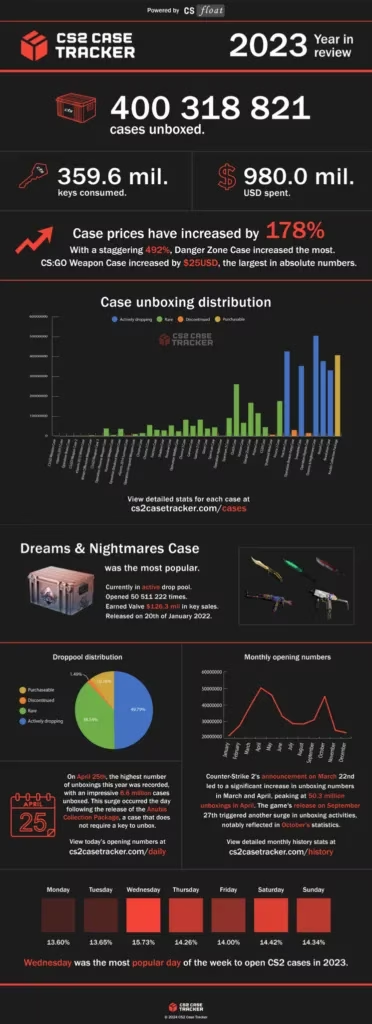
Even in 2026, the commercial footprint of Counter-Strike 2 continues to anchor Valve’s position in the live-service shooter market. A frequently cited year-end review by CS2 Case Tracker, originally published in January 2024, still shapes conversations about virtual item economies because it revealed the staggering scale of CS2 case openings in 2023. According to the tracker’s estimates, which were based on FloatDB data, players opened approximately 400 million cases during the year. Since each opening typically requires a paid key, those unboxings translated into roughly $980 million in revenue for Valve. That figure alone made 2023 the most profitable case-opening year recorded for Counter-Strike at the time.

The statistic is even more striking when placed in the context of Counter-Strike’s long history. Counter-Strike 2 launched in September 2023 as a Source 2 replacement for Counter-Strike: Global Offensive, carrying over the weapon skin market, case mechanics, and inventory values that had become central to the franchise. Rather than cooling down during the transition, player engagement with cases accelerated. The yearly total demonstrates that cosmetic rewards remain one of the most powerful monetization engines in PC gaming, especially for a title that is otherwise free to play.
The Most Popular Cases of 2023
Among the hundreds of millions of unboxings, one case stood out: the Dreams & Nightmares Case. CS2 Case Tracker reported that players opened 50,511,222 Dreams & Nightmares Cases during 2023. Much of that demand was likely driven by the chance to obtain Gamma finish Butterfly Knives, a high-value reward that continues to attract collectors and traders years after its debut. The case’s popularity highlights how specific cosmetic finishes, rarity tiers, and knife animations can turn an otherwise standard container into a top-tier revenue generator.
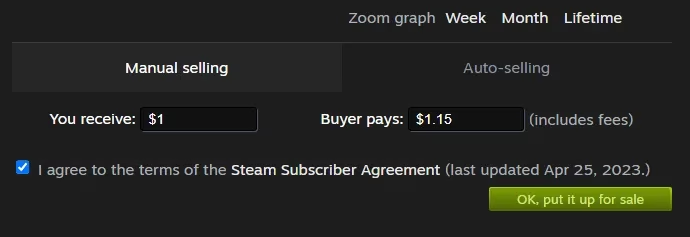
Other revenue streams sit alongside case openings. The Steam Community Market is another central piece of the CS2 economy. Valve takes a 17.25% cut of every Steam Market transaction, a fee structure that includes a baseline percentage plus an additional charge. While precise daily transaction volumes are not publicly disclosed, the size of the skin trading ecosystem suggests that market fees add a major secondary revenue source. In practice, every sale of a rifle skin, glove, knife, or sticker contributes directly to Valve’s bottom line, whether through case keys or market activity.
Revenue, Profit, and the Challenge of Estimation
Although the $980 million case-opening estimate is already enormous, industry observers consider it a conservative view of CS2’s total 2023 earnings. The addition of Steam Market fees, third-party marketplace interactions that still feed demand back into official systems, and other in-game purchases means Valve likely earned well above $1 billion from Counter-Strike 2 during the period. However, revenue is not the same as profit. Valve rarely releases production costs, and CS2 was one of the company’s largest projects, requiring years of engineering work on Source 2, networking, visuals, and backend infrastructure. Even without a precise profit figure, analysts argued at the time that the project was likely several hundred million dollars in the green.
Key figures from the 2023 review include:
-
📦 About 400 million cases opened by players
-
💰 Roughly $980 million generated from case keys
-
🔪 50,511,222 Dreams & Nightmares Cases opened
-
🛒 A 17.25% Steam Community Market transaction cut for Valve
Why the 2023 Numbers Still Matter in 2026
By 2026, the 2023 review remains an important benchmark. It showed that Counter-Strike 2 was not merely a technical upgrade but also an economic continuation of one of the most lucrative live-service franchises in gaming history. The scale of case openings explains why Valve has continued to update the game with new operations, sticker capsules, weapon collections, and community-driven content. It also illustrates why skin trading sites, inventory tools, and market trackers have become an entire sub-industry around the shooter.
Some fans voiced frustration that a game still missing certain CS:GO features could generate such enormous sums. Yet the financial result also created a clear incentive for Valve to keep investing. A title that produces hundreds of millions of dollars in recurring revenue is unlikely to be abandoned, which may explain the steady stream of patches, balance changes, and cosmetic releases that players have seen in the years since. In the live-service era, commercial success is often the strongest signal of long-term support.
In the end, the CS2 case economy is not just a story about loot boxes or key sales. It is a window into how modern competitive shooters sustain themselves. Virtual items, marketplace fees, and player-driven trading have turned a free tactical shooter into a billion-dollar ecosystem, and the data from 2023 remains one of the clearest public measurements of that momentum.