
The digital trading floors of Counter-Strike: Global Offensive have been plunged into an unprecedented deep freeze! In a seismic 2025 update that sent shockwaves through the global gaming community, Valve Corporation has unleashed a seven-day trade cooldown on every single item, skin, and cosmetic received via player-to-player trades. This isn't just an update; it's a tactical nuke aimed at the heart of CS:GO's legendary, volatile, and often lawless skin economy. Forget quick flips and instant gratification—now, every prized AWP Dragon Lore or glossy knife must sit in a digital quarantine for a full week before it can change hands again, effectively slamming the brakes on the high-speed, casino-like trading that defined the game for over a decade.
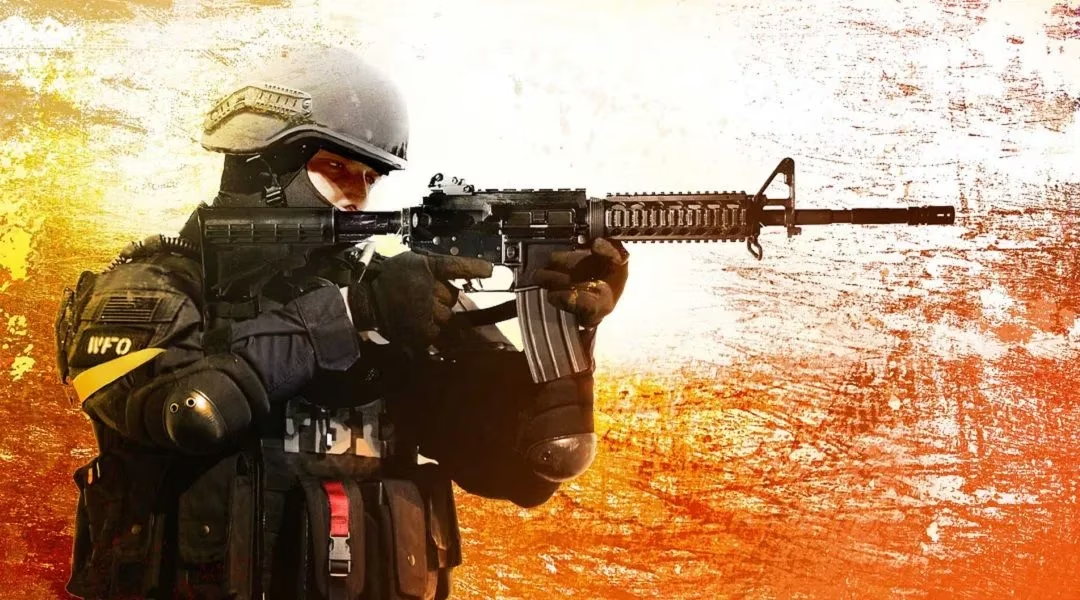
Valve's stated mission is noble: to purify the trading ecosystem from the scourge of fraud and scams that festered on third-party sites. In an official communiqué, the developer lamented, "Unfortunately, some of these third party services have become a vector for fraud or scams." They pointed out the fundamental difference between a casual player trading a skin once in a blue moon and the industrial-scale, millisecond-speed churning of assets by trading bots and services. "We want to make sure that Steam item trading is a useful feature that continues to provide customers with the freedom to give and receive items as they wish," Valve proclaimed, framing the cooldown as a necessary quarantine to save the patient. But the community's diagnosis? A catastrophic system failure.
🔥 The Instant-Gratification Economy, ANNIHILATED! 🔥
The old, wild-west system allowed a vibrant, parallel economy to thrive. Why? Because it offered something Steam's own market never could: instant cash-outs. Players sitting on a virtual goldmine—like that infamous $60,000 AWP Dragon Lore skin sold after a Cloud9 championship win—could bypass Steam Wallet funds and get real, spendable money via PayPal through these external sites. The lack of a cooldown was the engine of this entire industry. Sites could function as lightning-fast liquidity pools, letting users bid, win, and instantly receive or sell skins. Now, that engine has been replaced with a hand-crank that takes seven days to turn.
The fallout has been immediate and apocalyptic for a certain class of user. YouTube moguls, professional traders, and skin investors who built empires on the immediacy of trades are broadcasting their eulogies for the entire scene. Their business models, which relied on rapidly arbitraging price fluctuations across different platforms, are now as useful as a smoke grenade in a hurricane. The cooldown acts as a brutal stabilizer, intentionally designed to cripple the rapid speculative movement that led to insane price bubbles and crashes. Want to capitalize on a hype-driven price spike for a new sticker capsule? Think again—by the time your traded items are free from lockdown, the moment will have passed.
😱 Community Backlash: A Digital Uprising! 😱
-
Petition Power: A grassroots petition demanding Valve reverse this digital martial law has exploded, amassing over 118,000 furious signatures and counting. It's a clear signal that for many, trading was the endgame.
-
The Trader's Lament: "They've killed the game for collectors and traders," is the common refrain on forums. The joy of instantly swapping, upgrading, or showcasing a new acquisition is now buried under a week of waiting.
-
Economic Uncertainty: No one knows how this will affect long-term skin values. Will rarity and desire now be tempered by illiquidity, causing a market-wide depreciation? Or will the scarcity induced by slower circulation make existing items even more astronomically expensive?
Valve insists this is part of an ongoing evaluation, encouraging feedback. But for the legion of players who viewed their inventories as stock portfolios and trading as a core gameplay loop, this feels less like a policy tweak and more like a betrayal. The company draws a line in the sand: trading is a "feature," not the foundation of a secondary financial market. While this may indeed scorch the earth under scam operations, it also incinerates the legitimate, high-octane trading culture that grew around the game.
| The Old World (Pre-2025) | The New Frozen Wasteland (Post-Update) |
|---|---|
| Instant trades & cash-outs | Mandatory 7-day asset freeze ❄️ |
| Thriving third-party marketplaces 💰 | Crippled business models 📉 |
| High-risk, high-reward speculation 🎲 | Slowed, stabilized economy 🐢 |
| Fraud & scams as constant threat | Valve's promised "safer" environment ️ |
Only time will tell if this grand experiment will lead to a healthier, if slower, CS:GO ecosystem, or if it will be remembered as the moment Valve froze its own vibrant economy into a sterile, stagnant ice age. One thing is certain: the frantic, pulse-pounding era of instant skin trading is dead. Long live the… wait.