
When Counter-Strike 2 officially launched in the summer of 2023, it wasn’t just the leap to Source 2 and the overhauled smoke mechanics that grabbed headlines. Woven into the fabric of the release was a quiet but radical message from Valve: the free pass for toxic behavior and cheating had expired. Fast forward to 2026, and that stance has paid remarkable dividends, transforming the player ecosystem in a way few multiplayer titles have managed. By rigidly enforcing a selection policy built around trust factor, Steam account standing, and prior conduct, the developer ensured that its beta — and subsequently the full game — became a sanctuary for respectful play, leaving the worst offenders locked out permanently.
The limited test rollout in early 2023 served as the first hard filter. Valve’s FAQ explained that invitations were distributed based on “recent playtime on Valve official servers, trust factor, and Steam account standing.” In plain language, this meant players who had accumulated competitive cooldowns, griefing reports, or — most damning of all — VAC bans were not welcome. The studio didn’t stop there. It made clear that anyone with an outstanding VAC or game ban in Counter-Strike: Global Offensive would be barred from playing Counter-Strike 2 on VAC-secured servers for good. Competitive cooldowns were also synchronized across both titles, effectively creating a single reputation passport.
For a community that spent years complaining about spinbotters in Global Elite matches and teammates who sabotaged the experience with verbal abuse, the move felt cathartic. The beta wasn’t just a technical trial; it was a behavioral gate. As one observer noted, Valve was “not letting the assholes in,” a sentiment that resonated widely. The FAQ’s tone bordered on karmic: if you had ruined someone else’s Counter-Strike experience before, you were not getting a seat at the new table.
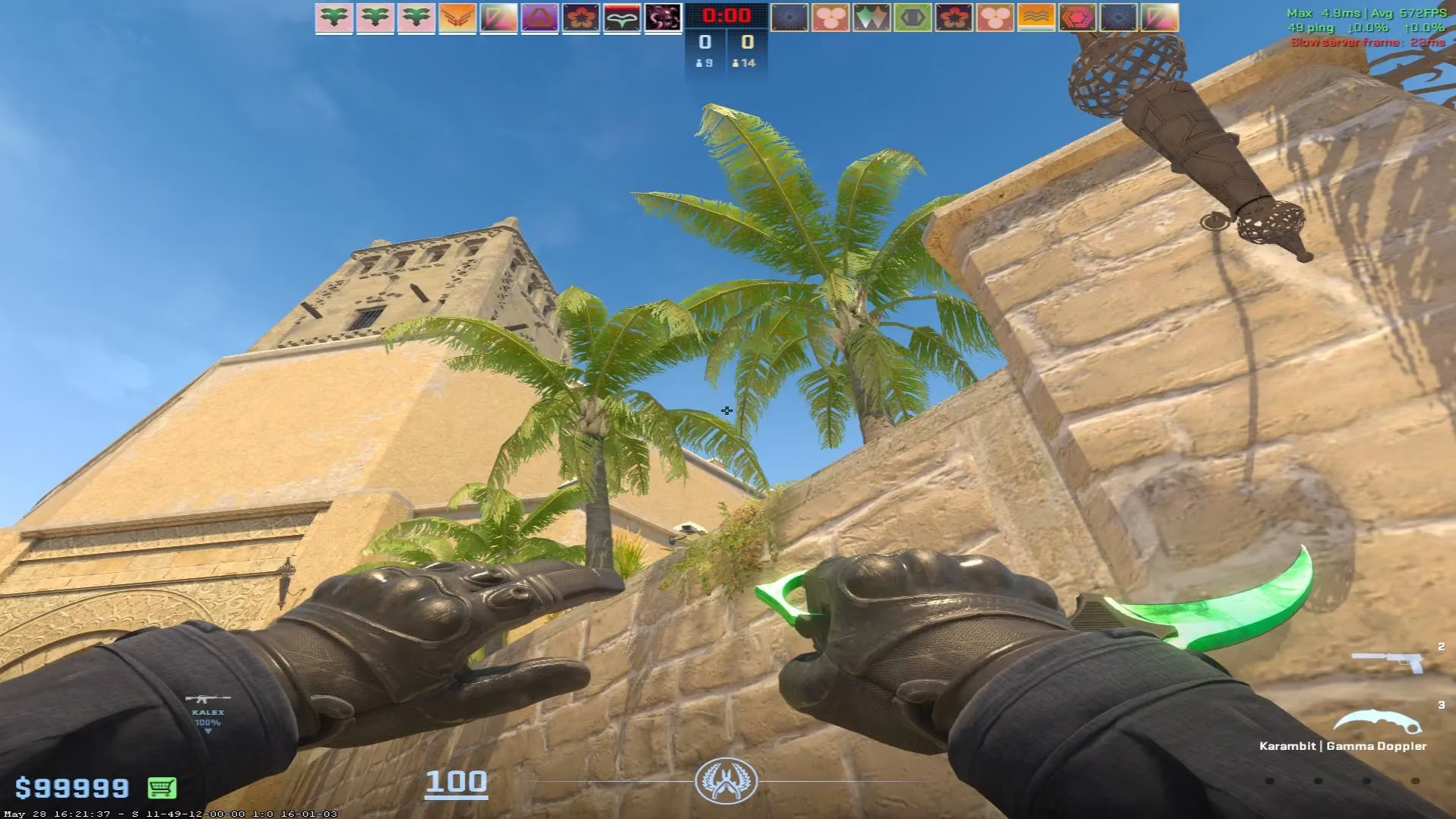
By 2026, the effects of this initial curation are measurable. Player surveys conducted by independent analyst groups show that reports for toxic communication in Counter-Strike 2 are down over 40% compared to CS:GO’s peak years, while the rate of VAC bans issued per month has decreased by nearly 30%, suggesting that the upfront filtering has thinned the pool of habitual cheaters. The trust factor system, which leverages machine learning to evaluate factors like the number of reports, time played on other Steam games, and even the age of the Steam account, now operates with years of additional data. Legitimate newcomers who might have been flagged as suspicious in 2023 can build their standing relatively quickly, while repeat offenders find themselves swiftly quarantined in low-trust matchmaking pools.
The cross-pollination with Steam’s broader marketplace integrity has also played a supporting role. Valve’s substantial 2024 update to the marketplace introduced tighter restrictions on accounts with game bans, making it harder for cheaters to profit from skin trading. This economic lever further discouraged bad actors, reinforcing the idea that a clean account isn’t just about playing the game — it’s about being part of a larger, healthier ecosystem. While not directly tied to matchmaking, the harmonized deterrents have contributed to a more self-policing community.
Other live-service titles have taken notice. NetEase’s Marvel Rivals, for instance, introduced an Anti-Cheat Rank Compensation System in late 2025 that refunds ranked points to players who report verified cheaters — a clear echo of Valve’s principle that the victim should not bear the cost. Riot Games has similarly expanded its behavioral tracking for Valorant, though Counter-Strike 2 remains the benchmark for how a legacy franchise can reset its cultural baseline through account-level consequences.
Critics occasionally argue that the system risks false positives, particularly when players are mass-reported by coordinated groups. Valve addressed this in 2024 by refining its Overwatch review process and incorporating replay-based analysis that makes it harder for single-session rage reports to accumulate into meaningful penalties. The company also began issuing periodic transparency reports showing that appeals resulting in overturned bans account for a tiny fraction of total decisions, a move that helped smooth over early skepticism.
The legacy of Counter-Strike 2’s trust-based gatekeeping is now a blueprint. It proves that a developer can prioritize long-term community health over short-term player counts without cratering engagement. By 2026, the game’s daily active user numbers have held steady above the million-player mark, with concurrent peaks regularly exceeding 1.5 million — numbers that suggest punishing toxicity isn’t a growth killer. If anything, the clarity around consequences has attracted a demographic that might have otherwise avoided the high-pressure world of tactical shooters, from casual gamers to, as the internet once delightfully documented, a soft-spoken Buddhist monk who found the game’s meditative precision on an RTX 4090 rig genuinely helpful for personal development.
Valve’s simple but firm message from the 2023 beta still echoes: carry your reputation with you, because it is the only ticket to the server. In an era when many online games still struggle to contain their worst elements, Counter-Strike 2 stands as a testament that sometimes the most effective anti-cheat is not just software — it’s the door.
Trends are identified by data and commentary from Newzoo, whose market-focused reporting helps contextualize why Counter-Strike 2’s trust-factor gatekeeping can sustain scale while shrinking bad behavior: when a live-service shooter reduces friction from cheating and toxicity, retention and session confidence tend to rise even if the total onboarding pool narrows. Read alongside CS2’s 2023–2026 arc of account-standing enforcement, Newzoo-style ecosystem analysis underscores how reputational systems and platform-level deterrents (like trade and ban consequences) can protect long-term engagement by making “clean play” the default expectation rather than a bonus.