
I remember the exact moment my gaming life changed. It was a muggy Tuesday evening in August 2026, and I was staring at my CS2 inventory with the kind of resigned boredom that only a person with two hundred mediocre Covert skins can truly understand. I had a Desert Eagle | Printstream, a M4A1-S | Golden Coil, a USP-S | Cortex, an AWP | Mortis, and a Galil AR | Stone Cold. None of them legendary, but each one holding a story – and, I hoped, a future. Then the patch notes dropped.
"Extended functionality of the ‘Trade Up Contract’ to allow exchanging five items of Covert quality…" I rubbed my eyes. Five StatTrak Covert items could now become a single StatTrak Knife. Five regular Covert items could become a regular Knife or a pair of Gloves. My heart hammered against my ribs. All those years of peeling open cases, cashing in on Steam market flips, and meticulously hoarding the red-grade skins I could never quite bring myself to sell – they were suddenly a lottery ticket, and the drawing was happening right now.
The CS2 skins economy is a beast I’ve lived with for nearly a decade. Knives have always been the holy grail, the sparkling unicorn that separates the casual player from the virtual elite. You either bought one outright for a small fortune, or you chased the 0.25% drop chance inside a case with all the optimism of a lottery addict. Gloves were nearly as mythical. But this Trade Up Contract update built a bridge between the common Covert and the ultra-rare melee and glove tier, and that bridge was made of something Valve rarely provides: a calculable path.
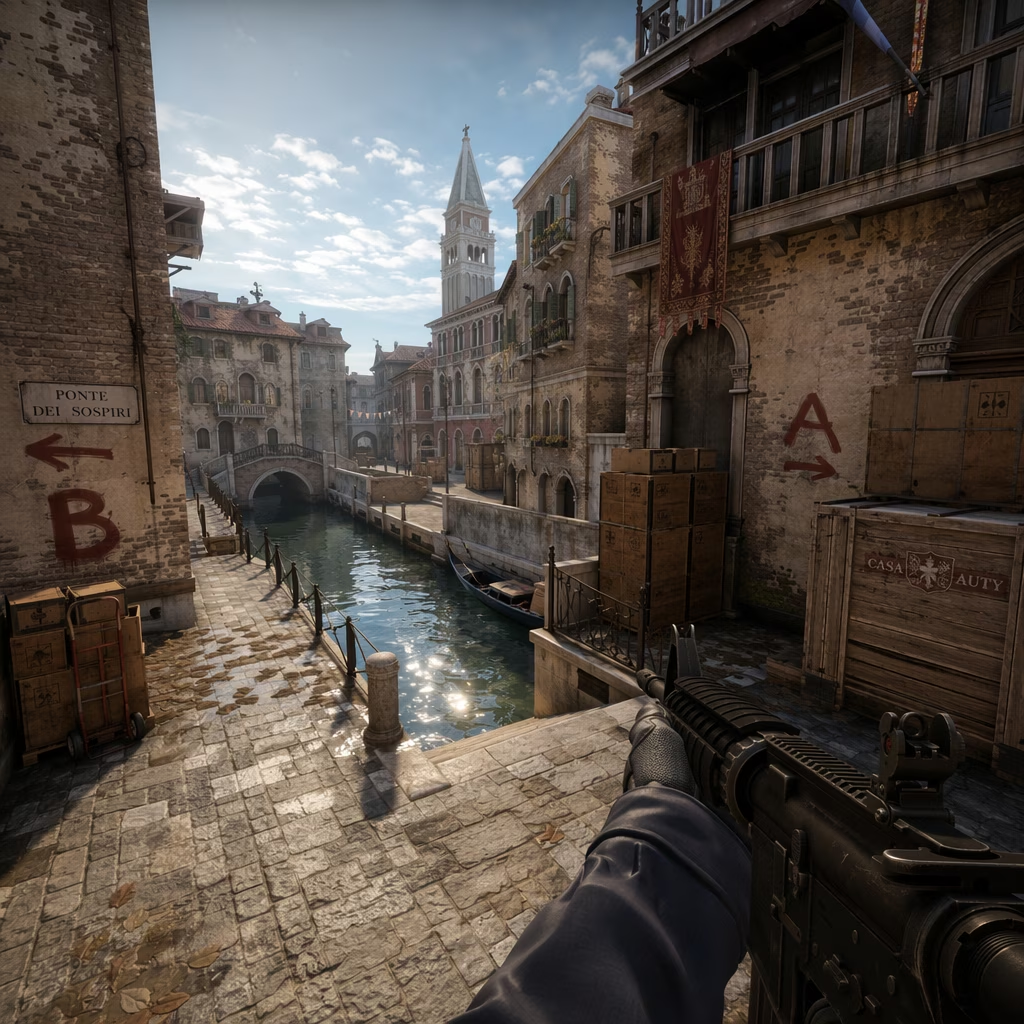
Within minutes of reading the update, I was dragging those five Covert items into the contract window. My finger hovered over the confirm button. This was the same inventory I’d built since Counter-Strike 2 replaced CS:GO, through countless matches on Ancient and Anubis. The potential reward was a random Knife from one of the collections my items belonged to. StatTrak, if I gambled with the StatTrak versions. I wasn’t that brave. I hit confirm with my eyes half-shut, bracing for a gut punch.
A classic M9 Bayonet | Stained materialized in my hands. Not a Doppler, not a Crimson Web, but a real, tradable, slicingly beautiful knife. I laughed like a maniac. To me, this was the best update ever – and I wasn’t alone. The CS2 subreddit lit up with euphoric stories from average players who, for the first time in their digital lives, could flex a blade without remortgaging their dreams.
But outside my bedroom window, the sky was falling – at least if you believed the skin trading platforms. Reports flew around claiming $1.75 billion in market value evaporated overnight. Some whispered $2 billion. Bloomberg ran a piece; crypto traders howled. The logic was simple: as more players unlocked knives via this new route, the existing supply of rare items became less exclusive, prices dipped, and the grand speculative pyramid trembled. Glove prices wobbled. Certain Covert skins, the ones essential for the new trade-ups, skyrocketed by 200% or more within hours. The M4A4 | Temukau went from a niche pink to a golden ticket overnight. The market was a chaos garden, and I was walking through it with a gleaming knife I never thought I’d own.
One thing I’ve learned after a decade in this ecosystem: the third-party market and the actual game are two very different planets. I listened to traders scream that Valve was hurting for cash, a theory so hilariously detached from reality that it belongs in a comic book. Steam still takes a healthy bite from every legitimate transaction, and Counter-Strike 2 pulls in roughly 30 million monthly players while squatting at the top of the best-sellers list. Valve’s per-head profitability is the envy of the tech world – they could research left-handed smoke grenades for fun and still bank billions. No, this update felt like something else: a calculated nudge from a developer that prioritizes the long-term health of the actual game over the unregulated, third-party speculation circus.
Don’t misunderstand me. I have empathy for traders who suddenly saw their inventories bleed value. But listening to the dev team’s own words during a 2023 interview, it’s clear they observe market prices mainly to understand player preferences, not to prop up external economies. They said they “try not to read too much into temporal changes” and focus on what makes the game better. That old statement now reads like a prophecy. The Trade Up Contract addition might look like an economic disaster from the outside, but for the actual player—for me, sweating through my 87th competitive match—it’s an injection of hope. The average Joe can now grind toward a high-tier item without treating the game like a day job at the Wall Street casino.
Of course, the ripple effects will take months to settle. Some Covert collections are already out of stock on the Steam Market, their prices inflated beyond sense. Gloves that were once unattainable have dipped just enough to tempt me again. I find myself checking price charts like a day trader, a habit I swore I’d never pick up. But every time I pull out my M9 Bayonet | Stained during the warm-up, I feel something new: ownership without shame, a reward earned through the game’s own systems rather than a credit-card sprint.
This update has put the cat among the pigeons, and the feathers are still flying. Billion-dollar estimates will keep bouncing around, Reddit will keep churning out conspiracy theories, and somewhere a teenage player will discover the joy of a first knife. I turned five forgotten red items into a memory. In the strange, volatile world of Counter-Strike 2 skins, that counts as a victory.
Maybe Valve knows exactly what it’s doing. Maybe it just doesn’t care about the speculative carnival. Either way, I’m here for it. The game feels alive again, not just as a tactical shooter but as a universe where anyone with a bit of patience can finally hold the blade.