
The roar of a passionate crowd has always been an integral part of the live esports experience, but what happens when that very energy begins to influence the outcome of the game on stage? This is the delicate balance that tournament organizer ESL sought to address head-on during the Intel Extreme Masters Katowice CS:GO championship back in 2020. The issue of crowd interference, where audience reactions inadvertently give away in-game information to players, had become a growing point of contention within the competitive scene. ESL's response was a pioneering set of crowd etiquette rules, complete with a unique deterrent: the potential removal of the spectator x-ray feature from the arena broadcast for over twenty minutes. This move sparked widespread discussion about the role of the audience in high-stakes esports.
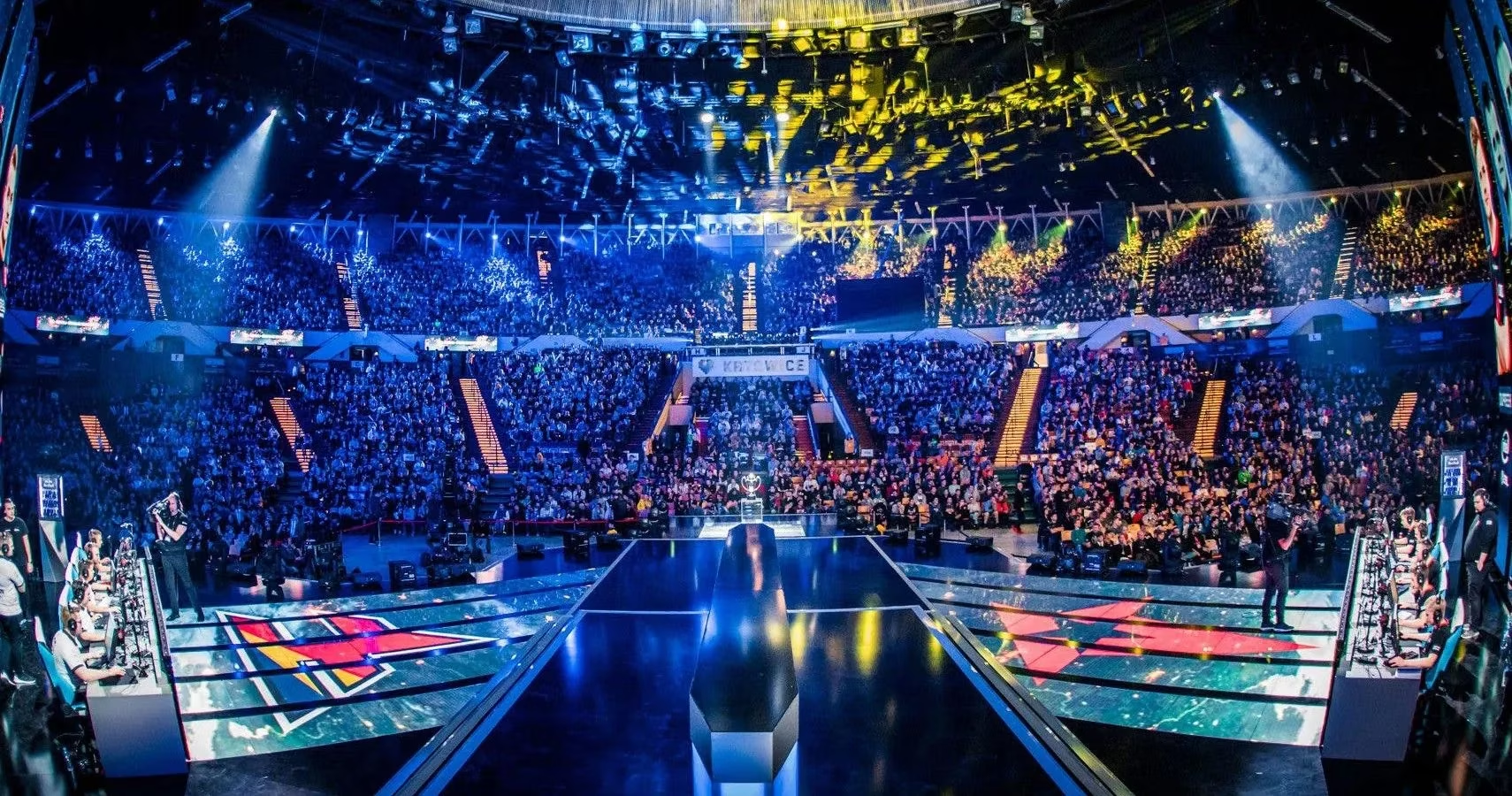
Why did ESL feel such measures were necessary? The catalyst was the ESL Pro League Season 10 Finals in Odense, Denmark, just a few months prior. The event was a home game for the then-dominant team, Astralis. Observers noted that the Danish crowd's cheers seemed to spike at moments that could clue Astralis players into enemy positions they couldn't see on their own screens—such as when an opponent was lurking just behind a wall. Was this merely enthusiastic support, or was it crossing a line into unfair advantage? This phenomenon wasn't isolated to Denmark; it had been observed at various tournaments worldwide, often tipping the scales in favor of the local team. The core of the problem lies in Counter-Strike's spectator x-ray feature. This tool, designed to enhance the viewing experience by outlining player models through walls, creates a fundamental information asymmetry: the crowd sees more than the competitors. When thousands of fans gasp or cheer because they see two outlines converging behind a barrier, that auditory cue becomes a tangible piece of intel for the players below.
ESL's Vice President of Pro Gaming at the time, Michal "Carmac" Blicharz, took the community's concerns directly to a Reddit forum. He outlined a graduated plan to curb this interference, especially as the tournament moved into the iconic Spodek Arena. The strategy was multifaceted:
-
Education First: The plan would begin with public service announcements (PSAs) played in the arena before matches. The goal was to educate fans on appropriate cheering etiquette, essentially answering the question: When should you hold your applause?
-
Clear Guidelines: Fans were explicitly asked to refrain from cheering in three key situations:
-
Before a knife kill is secured.
-
During moments of "trigger discipline" (when a player is holding an angle silently).
-
For any event or player position that the competitors themselves cannot see on their screens.
-
-
The Deterrent: If the crowd persistently violated these guidelines after warnings, ESL would enforce a penalty. The spectator x-ray would be disabled in the arena only for a period of 20 minutes or more. It was a punishment aimed directly at the live experience, reminding the audience that their privilege of enhanced viewing came with responsibility.
Carmac was careful to clarify that this penalty would not affect the online broadcast. Viewers on Twitch would continue to see the full x-ray feed uninterrupted. This highlighted that the rule was not about censoring the game, but about preserving competitive integrity on the stage itself. He framed ESL's approach as a collaborative effort: "We want to work with audiences to establish an etiquette of when to cheer and when to remain silent." The organization also reserved the right to remove any individual from the arena who egregiously violated the spirit of the rules.
Looking back from 2026, the IEM Katowice 2020 crowd rules can be seen as a landmark moment in esports production. It formally acknowledged that the audience is not a passive element but an active component of the competitive environment. The discussion it ignited has evolved. Today, tournament organizers employ even more sophisticated methods, such as sound-dampening player booths, directional crowd noise filtering for broadcast, and continued, more nuanced fan education. The core lesson remains: for esports to be taken seriously as a competition, every possible variable—even the decibel level of a home-crowd cheer—must be considered and managed. The goal is not to silence passion, but to ensure that the victory celebrated at the end of a grueling series, like the $250,000 grand prize awarded at that IEM Katowice, is won solely through skill and strategy, not aided by an unintended whisper from the stands.