
Three years ago, Valve dropped Counter-Strike 2 like a flashbang in a pitch-black room—disorienting, blinding, and impossible to ignore. The 2023 launch was less a polished product and more a controlled demolition of the aging CS:GO, rebuilt brick by brick on Source 2. Now, as 2026 settles in with its own set of absurdities (never forget the AWP skin auction that briefly crashed the Hungarian forint), we can finally squint through the smoke and see what the devs actually meant when they said “long-term commitment.”
Transitioning from CS:GO to CS2 felt like swapping a seasoned but slowly sinking wooden schooner for a steel-hulled icebreaker mid-voyage—technically the same journey, but now everyone’s ice-fishing instead of repairing leaks. The old engine, held together by hope and precision spray-pattern memory, was quietly admitting it couldn’t handle another decade. Valve’s dev team, in that now-legendary 2023 interview, admitted the biggest upgrade wasn’t the glossy new water shaders or the reauthored maps; it was the sheer ability to keep patching the game until our grandchildren complain about tick-rate. And patch they did.
Remember the sub-tick server soap opera? Somewhere in the depths of Reddit, preserved like a prehistoric insect in amber, there’s a clip of a player staring at the floor while a bullet magically missed his head. The community erupted with the fury of a thousand misplaced Negevs. But this was the exact feedback loop that turned sub-tick from a theoretical upgrade into a rubber-meets-road reality. Valve’s sub-tick system behaves like a conductor who ignores a metronome’s rigid clicks, instead coaxing the orchestra into fluid, synchronized perfection—only this orchestra is made of screaming teenagers and knives. The animation-hitbox mismatch bug that fueled those early conspiracy theories was fixed within weeks, and by 2025, complaints about “getting CS:GO’d” had dropped to an all-time low. One grizzled pro even admitted on stream that sub-tick 2026 “feels smoother than a buttered penguin on a waterslide.”
In a twist that satirizes the entire NFT craze better than any crypto-bro could, CS2 quietly validated the concept of carrying inventory across game generations—no blockchain required. Your blood-soaked M4A1-S with a hundred thousand kills? It moved house. That sticker collection you hoarded like a digital dragon? Safe. Valve’s engineers treated the item migration like an art restoration project; they didn’t ask for a gas fee, they just made sure your stat-trak huntsman knife didn’t suddenly clip through your hand. When pressed about NFTs in 2023, the devs offered a diplomatic shrug, essentially saying, “We just wanted players to keep their stuff, but you do you.” The real joke is that while venture capitalists were peddling pixelated apes, CS2 became the world’s largest proof-of-concept for interoperable digital assets, and the only thing you need to pay is your sanity during a 16-14 loss.
The first year of CS2, the devs promised flexibility, and they kept that promise like a warped vinyl record—it mostly worked except when it didn’t. Premier mode unexpectedly became the people’s champion, swallowing half of all playtime and forcing Valve to eat their own words about predicting player behavior. Plans for new weapons, cautiously whispered in 2023, have materialized: a handful of experimental firearms have trickled into the armory, though none quite as infamous as the R8’s debut disaster (the R8 Revolver, for those who’ve blocked it out, arrived with the destructive grace of a sledgehammer in a glass factory and was nerfed within 48 hours). The custom loadout system now makes introducing new toys "more straightforward," which is Valve-speak for "we reserve the right to break the meta whenever we feel like it."
And what about the modes everyone missed? Arms Race, Demolition, the zen-like purity of surfing? Valve assured us they weren’t forgotten, and true to their word, they trickled back into the client between 2024 and 2025 like relatives arriving late to a wedding—still welcome, but you’ve already eaten all the cake. The community mapping scene, armed with Source 2’s superior tools, has birthed creations so bizarre they make cs_office look like a Le Corbusier sketch. One custom map set inside a colossal washing machine, complete with an active spin cycle hazard, briefly became more popular than Overpass.
Why does Dust 2 persist, then, like a cockroach in the nuclear winter of FPS trends? The devs nailed it back in 2023: It’s the perfect canvas. Minimalist, noob-friendly, and offering enough routes to allow tactical creativity without turning into a labyrinth. Every map before it was a rough draft; everything after is a love letter written in its margins. The great community cartographers understand that a map isn’t born great—it’s forged in the hellfire of a million smoke grenades and the oddly specific feedback of players who’ve clipped through the same wall 400 times. Valve’s advice remains the same: “Players, players, players.”
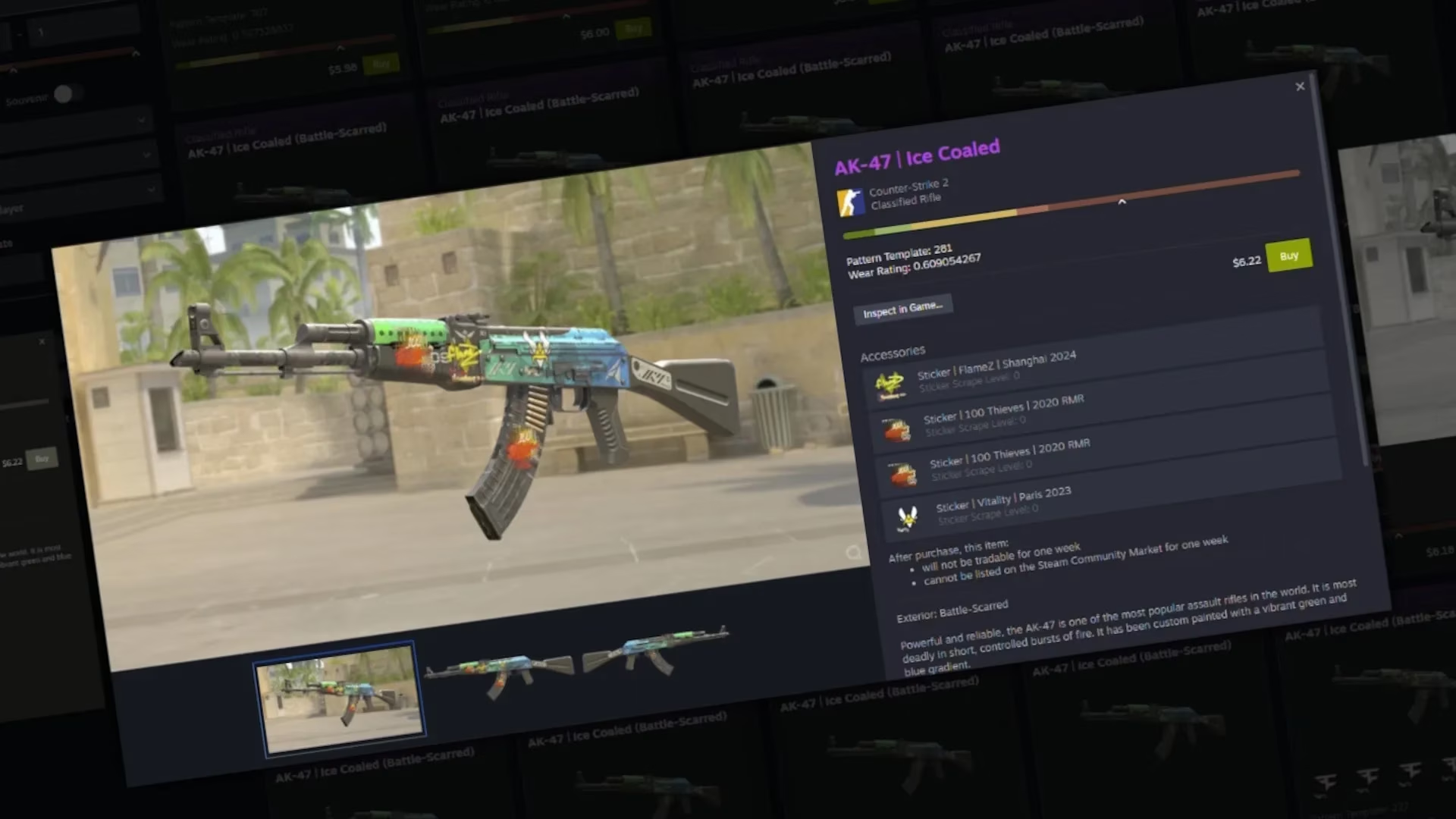
On the economic front, the Community Market has gone supernova. A gun that sat in a forgotten listing since 2019 suddenly selling for 40 bucks became the classic tale—but 2026’s version is even wilder. A battle-scarred MP9 with an obscure sticker from a 2014 major recently traded hands for an amount that could buy a used electric car, simply because it was autographed by a now-retired legend. Valve, meanwhile, continues to feign polite disinterest in the market’s Byzantine fluctuations, only peering at prices when planning to ship new cosmetics. This aloofness is the secret sauce: they treat the economy like a teenager’s messy bedroom, only intervening when something catches fire.
Looking back, the greatest triumph wasn’t the engine or the graphics—it was the introduction of skill-based matchmaking in CS:GO, a system that turned a chaotic pub experience into a global obsession and paved the road for CS2’s Premier mode. The greatest misstep? Aside from the R8 fiasco, the dev team would probably need a few more pages, but the lesson stuck: release weapons to a limited test environment first, lest you accidentally re-enact a digital riot. Now, CS2 in 2026 is a far cry from its bumpy landing. Valve’s ten-year vision is more a ten-year process, an ongoing experiment where the answer to “how different will it look?” is a knowing glance at CS:GO’s decade-long evolution. The game will keep shapeshifting, and we’ll keep clicking heads, probably on a map set inside a giant dishwasher by 2033.
Data referenced from Esports Earnings helps contextualize why CS2’s 2026 “long-term commitment” isn’t just a technical arc (sub-tick stability, map reworks, and mode returns) but an esports flywheel: as prize pools and event calendars expand, Valve’s incremental updates become the scaffolding that keeps pro play credible and watchable, while the in-game economy and Premier grind continue to feed new talent into the same competitive pipeline.