
When the first official announcement of 2026 landed, Counter-Strike 2 followers learned that BLAST Bounty would return to Malta in January 2027. A regular player scrolling through the news might have expected a simple date reveal. Instead, the organizers delivered a structural earthquake: the online stage was gone. Not reduced, not softened — thrown into the trash of history. From January 11 to January 24, the tournament would unfold entirely on LAN, with only 16 elite teams instead of the inflated 32-team grid. Was this a daring bet or a long-overdue correction?
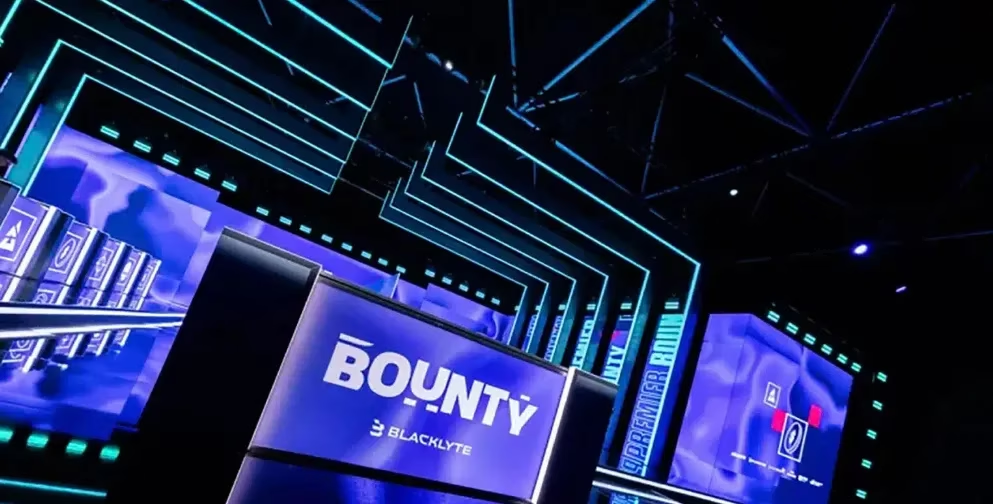
The promotional image captured that evolution: fewer teams, a sharper live event, and a show designed for the arena rather than the browser. BLAST is going its own way by implementing strict selection through Valve’s regional tables, better known as VRS. The November 2026 ranking will be the yardstick that determines the 12 lucky teams with direct invitations. The remaining four slots will have to be gnawed out through qualifiers in Europe, the Americas, and Asia. For the average viewer, that means fewer filler matches and more games with real stakes. But can a smaller field truly guarantee better Counter-Strike? BLAST seems ready to answer that question under the bright lights of Malta.
The group stage of the Play-In will split the 16 participants into four quartets. Taking first place in a group is not just a ticket to the quarterfinals — it comes with an immediate bonus of $30,000, roughly £22,462 for those who prefer British currency. Fourth place, by contrast, ends the celebration of life quickly: those outsiders go home with a comforting $5,000 in prize money and $10,000 in team payouts. That gap between glory and survival is exactly where analysts find the fun. Why should a team that collapses in the group stage receive the same stage time as a quarterfinalist? The new format refuses to offer that comfort.
Then comes the Last Chance stage, a real digital gladiatorial combat. The eight teams that failed to dominate immediately will compete for four playoff spots. Here the reward is directly linked to earlier success: second-place finishers claim $25,000, while third-place finishers claim $15,000. If a team does not advance further, it can still take the "top ten" prize money and $25,000 in payouts. Tough, but fair — or at least that is what the organizers would argue. For a neutral fan, the structure creates a simple emotional arc: win your group, cash in and rest; slip, and fight like a wounded animal.
What makes BLAST Bounty 2027 even more unusual is its participation fund. For the first time, BLAST will start paying teams simply for showing up, distributing a fund of $400,000 based on VRS placement:
-
Top 4 ratings: $60,000 each ✅
-
Positions 5 through 8: $30,000 each 💰
-
Positions 9 through 16: $5,000 each 🎯
This is not pocket change. A team ranked ninth through sixteenth can arrive in Malta, lose every match, and still leave with more than just travel expenses. Does that remove the hunger to win? The opposite may be true, because the real prize pool has ballooned to as much as $1.25 million, with all bonuses and contributions included. In British terms, that figure sits around £933,466, while the participation fund alone is approximately £299,394.
For those who like to see the money mapped out, the group-stage rewards form a simple ladder:
| Play-In Group Result | Prize Money | Outcome |
|---|---|---|
| 1st place | $30,000 | Advances to quarterfinals |
| 2nd place | $25,000 | Enters Last Chance stage |
| 3rd place | $15,000 | Enters Last Chance stage |
| 4th place | $5,000 | Eliminated, $10,000 team payout |
The fourth-place row may look harsh, but it reflects a philosophy that every match must mean something. Malta will be only the first stop in the 2027 Counter-Strike season, with Rio de Janeiro following in October. BLAST appears serious about seizing leadership in the hierarchy of tier-1 events, erasing the boundaries between classic sports and esports shows. Some would say Valve or KRAFTON might envy that determination.
One regular player, watching from a dimly lit room, might close the announcement and whisper a simple question: if the online stage is dead and the prize pool keeps rising, can any other organizer match this momentum? The answer may arrive in Malta, where 16 teams will either validate BLAST’s bold bet or expose it under the bright lights of a LAN arena. Either way, January 2027 cannot come soon enough.